Leading global health experts did not anticipate the scale of the Ebola outbreak, a senior health official has told the BBC.
Chris Dye from the World Health Organization (WHO) said the international response was helping but needed to continue.
Ebola is entrenched in the capitals of the worst-affected countries - Guinea, Liberia and Sierra Leone, the WHO says.
The outbreak has killed more than 3,860 people, mainly in West Africa.
More than 200 health workers are among the victims.

Please turn on JavaScript. Media requires JavaScript to play.
WHO's Dr Chris Dye: We didn't anticipate this outbreak was going to be this big
Mr Dye said that that although no-one was in a position to anticipate the scale of the current outbreak, the important thing was to look forward.
"We've asked for a response of about $1bn (£6.18bn); so far we have around $300m (£185m) with more being pledged, so a bit less than half of what we need but it's climbing quickly all the time," he said.
In April, the medical charity Medecins Sans Frontieres (MSF) warned of the potential spread of the virus, but the WHO played down the claims, saying that Ebola was neither an epidemic, nor was it unprecedented.
On Friday MSF reported a sharp increase of Ebola cases in the Guinean capital, Conakry, dashing hopes that the disease was being stabilised there.
Meanwhile in Mali, an experimental serum is being tested on volunteer health workers.
The trial spans several countries, and the results will be sent to experts to determine whether it is able to protect against Ebola.
Meanwhile in Spain, seven more people are being monitored in hospital for Ebola.
They include two hairdressers who came into contact with Teresa Romero, a Madrid nurse who looked after an Ebola patient who had been repatriated from West Africa.
Ms Romero is now reported to be gravely ill but stable.
In other developments:
- More than 1,300 Nigerian peacekeeping troops have been quarantined in Liberia after coming into contact with a Sudanese man who later died of the disease
- In Liberia, senate elections due next week have been postponed to help reduce the risk of voters spreading the virus
- More details of how passengers at some British airports will be screened are expected to be announced later on Friday
- The US begins its programme of enhanced screening this weekend at five of its major airports, including JFK
- A Texas county sheriff deputy quarantined after visiting the home of the first person diagnosed with Ebola in the US has been given the all-clear.
How not to catch Ebola
- Avoid direct contact with sick patients
- Wear goggles to protect eyes
- Clothing and clinical waste should be incinerated and any medical equipment that needs to be kept should be decontaminated
- People who recover from Ebola should abstain from sex or use condoms for three months
Why Ebola is so dangerous
How Ebola attacks
Ebola: Mapping the outbreak
|
Source: NHS and World Health Organization |
|
People can catch Ebola if they are in direct contact with the bodily fluids of an infected person or animal |
|
Early symptoms include fever, muscle pain, headache and sore throat. This is followed by vomiting, diarrhoea and bleeding, sometimes from the eyes and mouth |
|
The current outbreak started in March in west Africa, where the worst-affected countries include Guinea, Sierra Leone and Liberia |
|
It is thought unlikely that the disease would spread if it did come to the UK because quarantine and communications are more developed than in parts of western Africa |
|
There is no licensed Ebola vaccine but treatments are in development |
INTERACTIVE
- ×
- ×
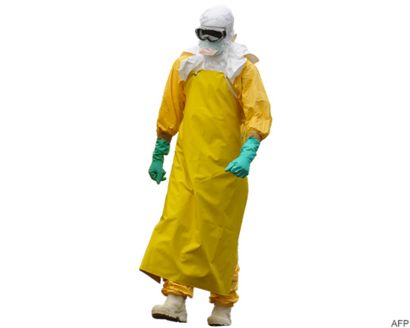
The cap forms part of a protective hood covering the head and neck. It offers medical workers an added layer of protection, ensuring that they cannot touch any part of their face whilst in the treatment centre.
- ×
Goggles, or eye visors, are used to provide cover to the eyes, protecting them from splashes. The goggles are sprayed with an anti-fogging solution before being worn.
- ×
Covers the mouth to protect from sprays of blood or body fluids from patients. When wearing a respirator, the medical worker must tear this outer mask to allow the respirator through.
- ×
A respirator is worn to protect the wearer from a patient's coughs. According to guidelines from the medical charity Medecins Sans Frontieres (MSF), the respirator should be put on second, right after donning the overalls.
- ×
A surgical scrub suit, durable hospital clothing that absorbs liquid and is easily cleaned, is worn as a baselayer underneath the overalls. It is normally tucked into rubber boots to ensure no skin is exposed.
- ×
The overalls are placed on top of the scrubs. These suits are similar to hazardous material (hazmat) suits worn in toxic environments. The team member supervising the process should check that the equipment is not damaged.
- ×
A minimum two sets of gloves are required, covering the suit cuff. When putting on the gloves, care must be taken to ensure that no skin is exposed and that they are worn in such a way that any fluid on the sleeve will run off the suit and glove. Medical workers must change gloves between patients, performing thorough hand hygiene before donning a new pair. Heavy duty gloves are used whenever workers need to handle infectious waste.
- ×
A waterproof apron is placed on top of the overalls as a final layer of protective clothing.
- ×
Ebola health workers typically wear rubber boots, with the scrubs tucked into the footwear. If boots are unavailable, workers must wear closed, puncture and fluid-resistant shoes.
Are you in West Africa? How has Ebola affected you? You can email your experiences to haveyoursay@bbc.co.uk.
Have your say
Anda sedang membaca artikel tentang
WHO: 'Ebola bigger than anticipated'
Dengan url
http://worldartikelku.blogspot.com/2014/10/who-ebola-bigger-than-anticipated.html
Anda boleh menyebar luaskannya atau mengcopy paste-nya
WHO: 'Ebola bigger than anticipated'
namun jangan lupa untuk meletakkan link
WHO: 'Ebola bigger than anticipated'
sebagai sumbernya


0 komentar:
Posting Komentar