
Please turn on JavaScript. Media requires JavaScript to play.
Many health workers have died from Ebola in Liberia
Liberian health officials are appealing to nurses and medical assistants not to go ahead with a national strike, as the Ebola epidemic continues.
The National Health Workers Association wants an increase in the monthly risk fee paid to those treating Ebola cases.
In the US, President Barack Obama has directed more steps to be taken to ensure high safety procedures when dealing with suspected Ebola patients.
A health worker treating an Ebola victim has herself caught the virus.
Liberia's Assistant Health Minister Tolbert Nyenswah said a strike would have negative consequences on those suffering from Ebola and would adversely affect progress made so far in the fight against the disease.
The government says the scale of the epidemic means it now cannot afford the risk fee originally agreed.
The risk fee is currently less than $500 a month, on top of basic salaries of between $200-$300. Staff are now seeking a risk fee of $700 a month.
The health workers also want personal protective equipment and insurance.
Ninety-five of their colleagues have so far died from Ebola. Liberia is one of the countries worst affected by the epidemic.
More than 4,000 people have so far died in the outbreak.
A new UN centre to co-ordinate the fight against the epidemic is being set up in Ghana.
UN aid workers and logisticians are being flown in to Accra, the BBC's Mark Doyle reports. Ghana itself has not so far seen any Ebola cases.
Six months after the epidemic began in west Africa there are still only about a quarter of the treatment beds required to tackle it.
Food is now in short supply as markets are disrupted in some parts of the three countries worst affected: Liberia, Sierra Leone and Guinea.
In Liberia, elections have been postponed because the gathering of people at polling stations would endanger lives.
US inquiry
Please turn on JavaScript. Media requires JavaScript to play.
Dr Tom Frieden, CDC: "At some point there was a breach in protocol"
On Sunday evening, the US Centers for Disease Control and Prevention (CDC) confirmed that a female health worker had tested positive for Ebola in Dallas.
CDC chief Dr Tom Frieden has promised a full inquiry into how the transmission could have occurred.
The CDC investigation, he told reporters, would focus on possible breaches made during two "high-risk procedures", dialysis and respiratory intubation.
The health worker at Texas Health Presbyterian Hospital had been treating Ebola victim Thomas Eric Duncan, who caught the virus in his native Liberia and died on Wednesday.
She is now on an isolation ward and is said to be in a stable condition.
Dr Frieden said 48 other people who may also have had contact with Duncan were being observed.
Duncan tested positive in Dallas on 30 September, 10 days after arriving on a flight from Monrovia via Brussels.
He had become ill a few days after arriving in the US, and went to the hospital in Dallas with a high fever.
Symptoms of Ebola include fever, headache, vomiting, diarrhoea and bleeding. The virus is spread through contact with bodily fluids.

Please turn on JavaScript. Media requires JavaScript to play.
Alastair Leithead, outside the hospital, said the investigation is on-going
INTERACTIVE
- ×
- ×
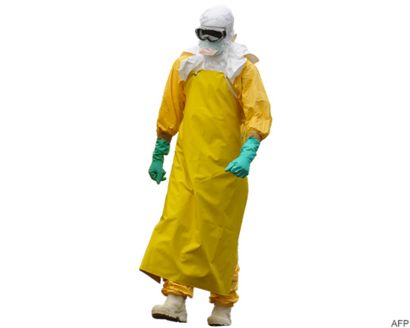
The cap forms part of a protective hood covering the head and neck. It offers medical workers an added layer of protection, ensuring that they cannot touch any part of their face whilst in the treatment centre.
- ×
Goggles, or eye visors, are used to provide cover to the eyes, protecting them from splashes. The goggles are sprayed with an anti-fogging solution before being worn.
- ×
Covers the mouth to protect from sprays of blood or body fluids from patients. When wearing a respirator, the medical worker must tear this outer mask to allow the respirator through.
- ×
A respirator is worn to protect the wearer from a patient's coughs. According to guidelines from the medical charity Medecins Sans Frontieres (MSF), the respirator should be put on second, right after donning the overalls.
- ×
A surgical scrub suit, durable hospital clothing that absorbs liquid and is easily cleaned, is worn as a baselayer underneath the overalls. It is normally tucked into rubber boots to ensure no skin is exposed.
- ×
The overalls are placed on top of the scrubs. These suits are similar to hazardous material (hazmat) suits worn in toxic environments. The team member supervising the process should check that the equipment is not damaged.
- ×
A minimum two sets of gloves are required, covering the suit cuff. When putting on the gloves, care must be taken to ensure that no skin is exposed and that they are worn in such a way that any fluid on the sleeve will run off the suit and glove. Medical workers must change gloves between patients, performing thorough hand hygiene before donning a new pair. Heavy duty gloves are used whenever workers need to handle infectious waste.
- ×
A waterproof apron is placed on top of the overalls as a final layer of protective clothing.
- ×
Ebola health workers typically wear rubber boots, with the scrubs tucked into the footwear. If boots are unavailable, workers must wear closed, puncture and fluid-resistant shoes.
Source: WHO
Note: figures have occasionally been revised down as suspected or probable cases are found to be unrelated to Ebola. They do not include one death in the US recorded on 8 October.
How not to catch Ebola:
- Avoid direct contact with sick patients
- Wear goggles to protect eyes
- Clothing and clinical waste should be incinerated and any medical equipment that needs to be kept should be decontaminated
- People who recover from Ebola should abstain from sex or use condoms for three months
Why Ebola is so dangerous
How Ebola attacks
Ebola: Mapping the outbreak
Have you been affected by the Ebola outbreak? Do you think enough is being done where you live to fight the disease? Tell us your story. You can email haveyoursay@bbc.co.uk.
Have your say
Send your pictures and videos to yourpics@bbc.co.uk or text them to 61124 (UK) or +44 7624 800 100 (international). Or you can upload here.
Read the terms and conditions.
Anda sedang membaca artikel tentang
Liberia strike threat over Ebola
Dengan url
http://worldartikelku.blogspot.com/2014/10/liberia-strike-threat-over-ebola.html
Anda boleh menyebar luaskannya atau mengcopy paste-nya
Liberia strike threat over Ebola
namun jangan lupa untuk meletakkan link
Liberia strike threat over Ebola
sebagai sumbernya


0 komentar:
Posting Komentar